- In conversation, most people call themselves a 7.
- Looksmaxing forums and r/truerateme decide what a 6 is without counting anyone.
- Measurement apps (golden-ratio overlays and landmark rulers) score distances, not how a face looks.
- Lookrank’s looks rating sits on the largest published 1–10 attractiveness sample we know of: 98,380 scores, typical error ±0.5, mean 5.94.
Why other 1–10s fail
Other systems guessed what a 6 looks like. They never counted who actually lands where. Each bar below is the same 1–10: pink is the part they actually use, and gray is unused.
Everyday 1–10
uses 6–91 to 4 are insults, and 7 is the polite default, so people almost never use the whole scale.
Looksmaxing forums (PSL)
uses 3.5–6.5Anonymous posters drew a ladder of cartoon types with no study, no counts, and no error bar behind the steps.
r/truerateme
uses 3.5–7Mods decide what a 6 looks like and ban overrating, without ever counting how many people are actually a 5 versus a 6.
Measurement apps
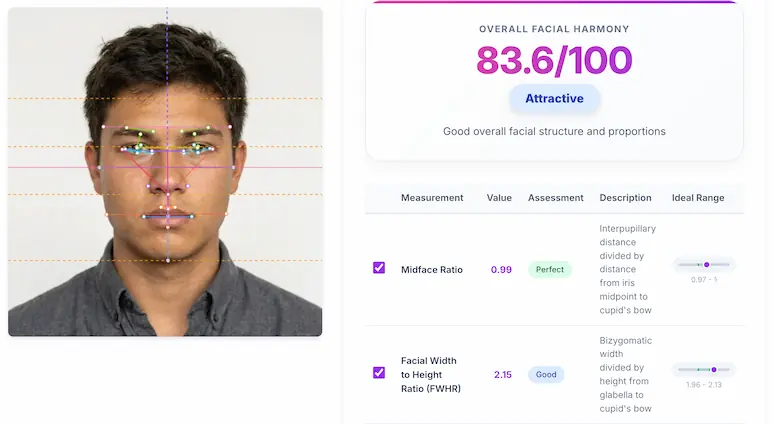
inaccurateGolden-ratio overlays and landmark rulers are usually the same product. They measure distances on a skull, so the same bone structure gets the same score even when the photos look different.
Lookrank 1–10
uses 1.0–9.9A visual model with a published sample of 98,380 scores, a typical error of ±0.5, and no 10.0 yet.
Everyday 1–10: everyone is a 7
In conversation, 1–10 is not a distribution. It is a social buffer. Scores 1 through 4 are reserved as insults. A 5, the mathematical midpoint, is processed as “you are hideous.” A 7 is the default of civil politeness.
Surveys of self-perception find that both men and women most commonly rate themselves a 7 out of 10 [1]. That clustering is why a statistically ordinary automated score feels like an insult. The instrument moved. The ego did not.
PSL: a made-up forum ladder
Looksmaxing forums, often grouped as PSL, drew a ladder of cartoon types from “below 3” up to a fictional ideal. The picture looks official. Nobody counted how many real faces sit in each step.
There is no sample, no error bar, and no study behind it. Anonymous users looked at a jaw, named a type, and the label stuck. The whole system runs on unnamed internet posters’ guesses, not measurement.
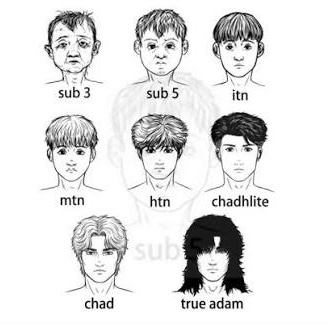
- No data. There is no published count of how many faces sit in each step. Lookrank publishes those shares on this page.
- Anonymous guesses. Ratings come from unnamed forum posters pointing at drawings and photos. There is no checked rater pool and no instrument.
- Unrealistic top end. The ceiling is models and edited photos, not people you meet.
r/truerateme: a 6 with no sample
The core problem is not the bell curve they drew. That curve was never fitted to real faces. A “6” on r/truerateme is a moderator’s guess of what a 6 looks like, enforced by bans. There is no table of how many people actually land at 5 versus 6 versus 7. The counts were invented, then policed.
They still wrote the invented curve down: mean 5.0, standard deviation 1.0. Under that formula, 7.0 is already about the 97.7th percentile, one in 44, and 8.0 is one in 740. By the three-sigma rule, 99.74% of living humans would have to sit between 2.0 and 8.0. That is not a 10-point scale. It is an amputated 6-point scale with two dead wings.
It also violates interval math. Moving from 5 to 6 covers about 34% of a normal distribution. Moving from 7 to 8 covers about 2%. Averaging those scores as if they were equal steps is bad math. And because overrating is a ban-able offense, commenters do not post what they see. They post the number that survives moderation.
5.35 is fake precision
Forum raters love “you are a 5.35, maybe 5.50 if you debloat.” Digits past the instrument’s error are fake precision. Lookrank’s typical error is ±0.5; against community votes the mean gap is 0.3 [2]. A 5.35 versus a 5.50 is not a finding. It is jitter.
Measurement apps are inaccurate
Golden-ratio overlays and landmark rulers are usually the same app: dots on a face, then a score from sizes. Interpupillary distance, jaw angle, third-to-third, or a 1.618 mask. Clinical studies have not backed the golden-ratio version [3] [4]. The landmark version has a simpler failure. Same skull, same number, even when the photographs do not look the same.
Skin, contrast, hair, fat, and photo angle actually move a rating. Those are not distances between points. Lookrank’s looks rating is a visual model. Lookrank also ships facial measurements, the same ruler as those apps, so you can see the flaw yourself.
Why 1–10, not 1–5
If a rating system parks almost everyone between 3 and 8, and treats 1, 2, 9, and 10 as empty, it should switch to 1–5. Everyday conversation does that: 1 through 4 are insults, 7 is the polite default. r/truerateme’s curve does that too. Under their formula, 99.74% of people would have to sit between 2 and 8. Those systems are running a 1–5 and calling it a 1–10.
A 1–10 where the ends cannot be used is not a 1–10. Lookrank still rates 1 to 10 because that is the scale people already understand. “On a scale of 1 to 10, where do I stand?” is the question. Relabeling it 1–5 would not make the middle clearer. It would make every comparison a conversion chart.
Most Lookrank scores also sit in the middle. In this sample, 94.3% land between 3.0 and 8.0. That is what a real distribution looks like [5]. The difference is the ends are not banned. 0.72% scored below 3. 4.94% scored above 8. 9.0 and above is 0.46%. There is no 10.0 because a 10 would require zero measurement error, not because the top bin is closed.
| System | Real usable range | What it is scoring |
|---|---|---|
| Everyday 1–10 | About 6–9 | Politeness. 1–4 are insults. |
| r/truerateme | About 2–8 | Moderator gut. The curve forbids the ends. |
| Measurement apps | Not a real 1–10 | Golden-ratio overlays and landmark rulers. Inaccurate. Same skull, same number. |
| Lookrank 1–10 | 1.0–9.9 | Visual model. Ends are rare, not banned. |
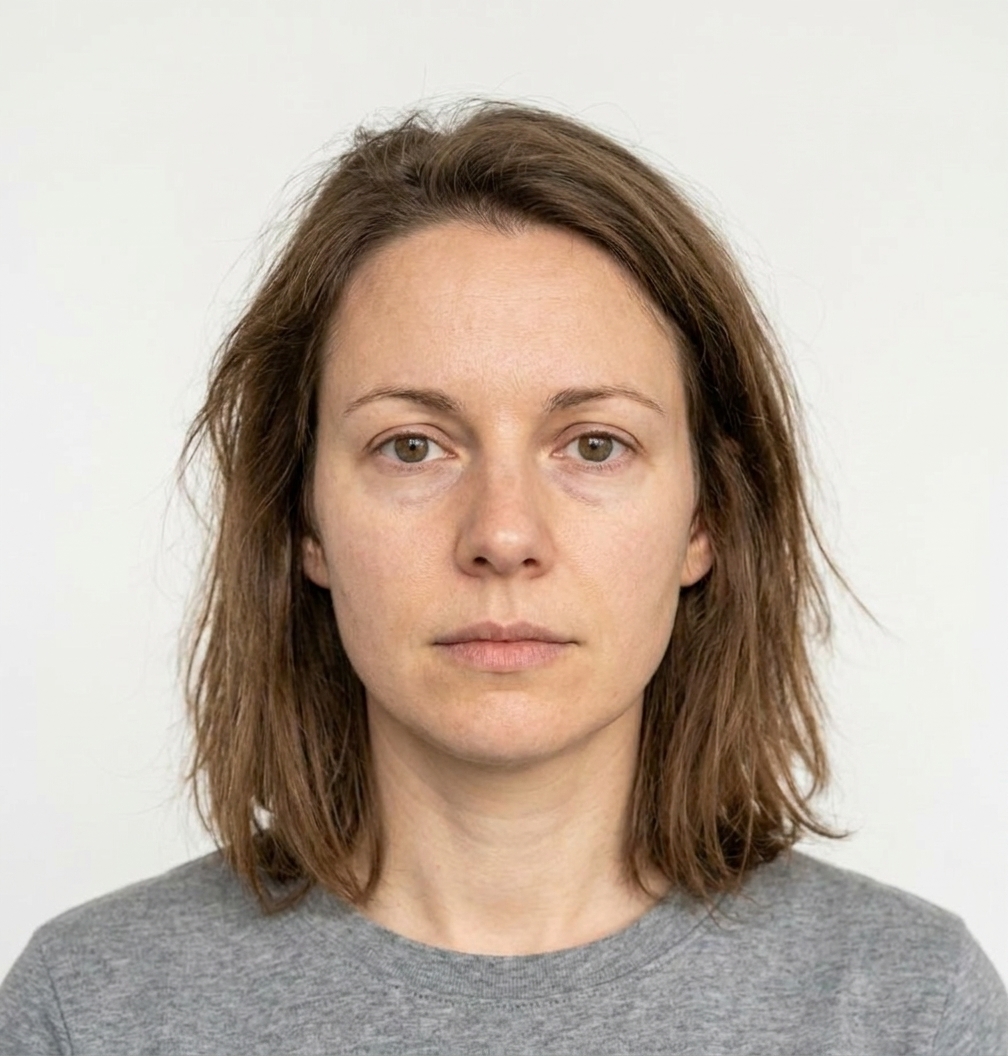
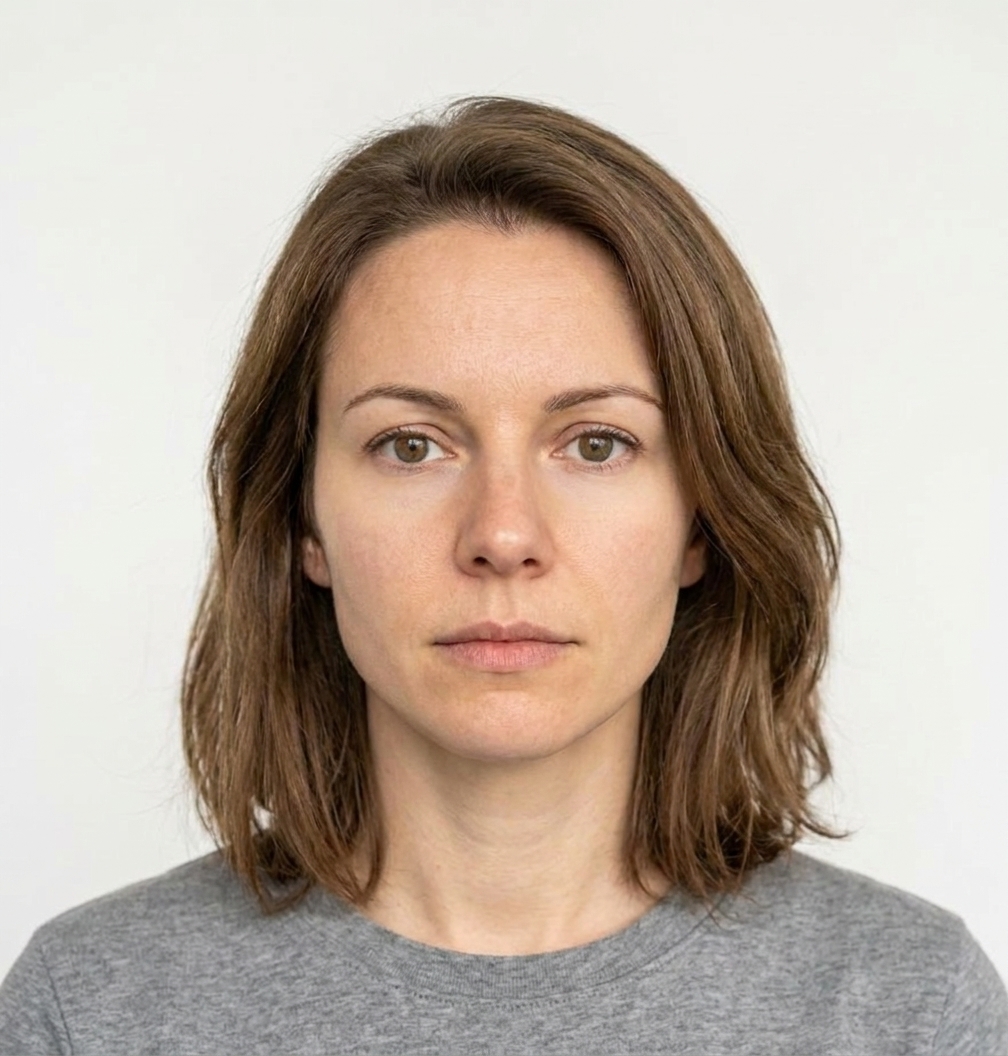
Measurement apps cannot honestly fill a 1–10. They score sizes on a skull. Ordinary faces do not have ten distinguishable skeleton steps. Lookrank’s looks rating is not a geometric measurement. It is a visual model with multiple analysis layers, so it can rank what bone math misses: skin, fat, contrast, hair, and presentation. That is why the two photographs above can land on different numbers, and why the extra points on a 1–10 are actually usable.
Facial harmony is measurable
If street ratings are ego and forum scores are whatever the mods allow, is attractiveness just private taste?
No. People converge on the same faces. Symmetry [6], mathematical averageness [7], sexual dimorphism, and skin evenness are shared signals, not a private language [8]. Lookrank’s internal comparison puts the model 0.3 points from community votes on average, with a typical error of ±0.5. Tenths of a point, not half the scale.
0.3 off community votes · typical error ±0.5
That is the width of disagreement the data actually shows. Lighting, angle, and photo quality still move a score. Private taste does not eat half the scale.
The Lookrank scale, from 98,380 real scores
Lookrank is a photo-based 1–10 estimate from a visual model. It is not a landmark count and not a geometric formula. The public sample on the statistics page is 98,380 anonymized scores as of 12 September 2026 [2]. That is the largest published 1–10 attractiveness score sample we know of. Rows are scores, not proven unique people. Repeated analyses can appear. This is a self-selected product sample, not a population census.
| Figure | Value | Read it as |
|---|---|---|
| Mean | 5.94 | Weighted average of the published sample. |
| Median | 5.9 | Half the scores sit at or below this. |
| Most common | 5.2 | 3,195 scores landed exactly here. |
| 9.0 and above | 0.46% | 456 scores. Highest recorded: 9.9, twice. No 10.0. The model is not finding a meaningful flaw. |
| Upper tail | 7.7 / 7.8 | 90.8% scored 7.7 or lower. 9.2% scored 7.8 or higher. |
| Typical error | ±0.5 | Lookrank’s usual estimated range on the current model, not a guarantee for every photo. |
| Gap vs votes | 0.3 | 0.3 off community votes on average. Internal comparison, not independent validation. |
Why isn’t the mean 5.0? Because people who upload to a rating tool are not a random draw of humanity. They are younger, more appearance-invested, and photographed on purpose. Lighting, angle, and model version also move the pile. A 5.94 mean is a product sample sitting above a theoretical midpoint. It is not proof that Lookrank users are “hotter than average.”
Users still write in that the model is “too harsh.” Internally, it rates slightly higher than community voters on average. The sting is the better-than-average effect: culture trained you to expect a polite 7. A 5.4 on an interval scale is an ordinary, harmonious face. It is not a slur.
A 9.0 or above is when the model cannot find a single meaningful flaw, and the face meets every visual criterion of attractiveness it uses. That is still not a 10.0. A 10 would require zero measurement error, and this sample has none.
Treat the far tails with caution. We suspect some users at the high and low ends are testing the model with CGI, movie characters, or heavily edited faces, not ordinary photos. Nineteen scores in this sample sit below 1.0 (0.02%). The card below is one of those tests.
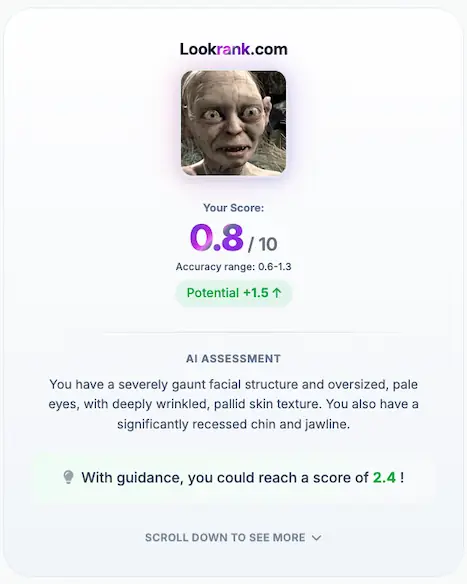
Rare (1.0–2.9)
Severe congenital syndromes, major reconstructive surgery, or traumatic injury. This band exists so the scale has a clinical floor. You almost never see it in ordinary online rating. It is not “ugly.” It is pathology and accident, and it is not the subject of grooming advice. A handful of scores also fall below 1.0. Some of those are people testing the model with fictional characters, not clinical faces.
Low (3.0–4.4)
These faces have several clear problems at once: a strong underbite or overbite, an uneven jaw, or a lot of facial fat and inflammation. Clinically that is marked Class II or III, vertical maxillary excess, mandibular asymmetry, or inflamed soft tissue. Improvement here is usually functional: airway, orthodontics, body composition, dermatology. Not a haircut.
Typical (4.5–5.9)
This is where a plurality of the sample lives, and where the most common score sits. Mild nasal humps, slight crowding, average cheekbone projection, ordinary skin. A 5.2 is not “ugly.” It is the mathematically normal human face doing standard bilateral symmetry. Typicality is what the scale actually rewards.
Grooming still changes the score. Body composition, skincare, brows, teeth, and a haircut that matches the skull are the boring levers that actually work. Bone is not the whole story, and forums that pretend otherwise are selling despair.
Above average (6.0–7.4)
Clearer mandibular borders, healthier skin chromophore distribution, decent occlusion, eyes that do not fight the rest of the face. In daily life these faces get complimented without anyone reaching for a decimal. It is the well-groomed professional / campus band, not a model card and not a forum insult.
High (7.5–8.4)
These faces look clearly above average in daily life, not like a polite 7. High symmetry plus stronger dimorphism: cheekbones, jaw angle, clean neck, even thirds, even skin. Small structural differences start to read as large rating jumps once the baseline is already balanced. That is why a real 7.8 feels rare and a polite 7 feels common.
Very high (8.5–9.4)
These are commercial and editorial faces, the kind that photograph easily. From about 9.0 up, the model is no longer finding a meaningful flaw. Rare combinations: compact midface, strong support around the eyes, dense bone, even soft tissue. The visual system spends less effort deciding the face is harmonious [9]. That efficiency is not a moral ranking. It is why these faces photograph “easy.”
Extreme (9.5–10.0)
A 9.0 or above is when the model cannot find a single meaningful flaw, and the face meets every visual criterion of attractiveness it uses. 9.5–10.0 is the far end of that band. A 10.0 would require zero measurement error. Lookrank has not issued one in this sample, and that is a feature. A system that hands out 10s is flattering, not measuring. Some high-end scores may still be edited faces or non-human tests, the same way the low end includes character uploads.
What moves, and what does not
Looksmaxing culture treats bone as destiny. Skin, fat, posture, and teeth are not bone. They are the high-mobility layer the model can actually see changing between photos.
| Dimension | Mobility | What that means |
|---|---|---|
| Skin evenness and texture | High | Homogeneous light return is a health cue. Lighting will fake this; consistent photos will not [10]. |
| Facial adiposity | High | A “recessed jaw” is often submental fat sitting on an ordinary mandible. |
| Posture and head carriage | Moderate | Changes the photo more than the skull. |
| Dental alignment | Moderate / high | Occlusion and display teeth are visible in every smile shot. |
| Craniofacial bones | Low | Surgery or time. Not a serum. |
One more practical trap: a 24mm phone selfie at arm’s length fattens the nose and pinches the temples. Track progress at 50–85mm equivalent, 1.5–2 meters, under diffuse light, or you will be rating lens distortion.
Reclaim the number
The 1–10 scale was wrecked twice: first by courtesy inflation that made 7 the new 5, then by forums that turned decimals into a ranking of types. Neither is measurement.
A Lookrank score is a calibrated photo estimate with a published sample, a published error bar, and an empty 10.0 bin. Use it as a baseline for grooming, health, and presentation.
How attractive are you?
Get your looks ratingReferences
- [1] Self-perception of physical attractiveness
- [2] Lookrank attractiveness study (2026). Distribution of 98,380 AI-rated scores. lookrank.com/Attractiveness.
- [3] Facial features and attractiveness analysis
- [4] Holland, E. (2008). Marquardt’s Phi mask: pitfalls of relying on fashion models and the golden ratio to describe a beautiful face. Aesthetic Plast Surg, 32(2), 200–8.
- [5] Is physical attractiveness normally distributed?
- [6] Facial symmetry and attractiveness
- [7] Averageness and symmetry in faces
- [8] Langlois, J. H., et al. (2000). Maxims or myths of beauty? Psychological Bulletin, 126(3), 390–423.
- [9] Neural processing of attractive faces
- [10] Skin texture and facial attractiveness
Edited by Alex Alstrom · Questions: [email protected]