How your face
impacts your life
Last updated: November 19, 2026
1. The Early Years: Education
Better GradesSource: [18]
Hernández-Julián and Peters compared in-person classes with online ones. Attractive students got higher grades when the teacher could see them. Once the work was anonymous, the gap was gone.
Teacher PerceptionsSource: [16]
Ritts, Patterson, and Tubbs reviewed the classroom studies in 1992. Teachers expected attractive students to be smarter, better behaved, and higher achieving, and that expectation showed up in how they talked to them and marked the work.
Professor EvaluationsSource: [17]
Theyson used RateMyProfessors, a ratings site. Students still scored better-looking instructors higher when the material was the same.
2. Social Perception & Dating
Looks vs. PersonalitySource: [5]
Witmer, Rosenbusch, and Meral ran a conjoint on dating-app profiles. Looks outweighed the biography, height, and job title by about 9 to 1 in who matched.
FunnierSource: [9]
Cowan and Little switched the channel. Attractive people got more laughs on video. On audio alone, the extra laughs fell away.
SmarterSource: [11]
Moore, Filippou, and Perrett had people rate faces for intelligence as well as looks. A prettier face was read as a smarter one, symmetry included.
HealthierSource: [10]
Zebrowitz and Montepare's review of face perception. Looks get used as a stand-in for health, including the guess that an attractive person is in peak condition.
More TrustworthySource: [12]
Klebl, Luo, and Bastian linked beauty to moral standing through perceived purity. A better-looking person was treated as having more integrity.
Second Dates & Speed Dating SuccessSource: [6]
Eastwick and Finkel's speed-dating study. Who wanted a second meeting followed physical attractiveness more closely than the personality measures collected that night.
"In Your League"Source: [7][8]
Luo reviewed assortative mating. Eastwick and colleagues meta-analyzed what people say they want. Stated taste and the couples who form are different things: partners usually land close in attractiveness.
3. Career & Economics
Higher SalariesSource: [1]
Hamermesh and Biddle's labor-market estimates. Attractive workers earned about 10-15% more a year than peers rated below average, with other job factors held constant.
More SalesSource: [4]
Reingen and Kernan, in a personal-selling setting. Customers were 55% more likely to buy, or to go along with a request, when they had rated the salesperson attractive.
Bigger TipsSource: [3]
Parrett's restaurant tipping study. Attractive servers took in about $1,261 more a year.
Easier Job InterviewsSource: [2]
Gilmore, Beehr, and Love, on interview decisions. Same résumé, different face: the better-looking applicant was judged more capable and hired more often.
Promotion LikelihoodSource: [25]
Hosoda, Stone-Romero, and Coats meta-analyzed experiments. Attractiveness predicted quicker promotions and kinder reviews from supervisors. It is one predictor in that set of studies.
4. Critical Outcomes: Justice & Health
Better Medical CareSource: [13]
The same paper: attractive patients were given more of the visit. That extra time is one reason the misses land on the other group.
Sentencing & CrimeSource: [19][20]
Beaver and colleagues followed youth and young adults through real case processing. Mazzella and Feingold pooled mock-juror experiments. Direction matches the rows above. The size of the gap depends on which of those two designs you read.
Longer LifespansSource: [15]
Henderson and Anglin used facial attractiveness to predict how long people lived. Longer lives sit next to more medical attention, and next to a social cushion that takes some stress out of the years.
5. Leadership & Global Influence
Political PowerSource: [22]
Berggren, Jordahl, and Poutvaara counted votes. More attractive candidates received more of them. Voters were using the face as a fast read on competence, and that read is often wrong.
Social Media EngagementSource: [26]
Wiedmann and von Mettenheim studied influencer profiles. More attractive profiles drew more favorable engagement and converted followers faster.
Better NetworkingSource: [21]
O'Connor and Gladstone mapped social networks. More attractive people built denser ties across groups. The extra information sat in those ties.
6. The Happiness Feedback Loop
Reported WellbeingSource: [23]
Datta Gupta, Etcoff, and Jaeger, in the Journal of Happiness Studies. More attractive people reported higher life satisfaction. The authors put that down to social and economic advantages adding up.
The Mental Health LoopSource: [24]
Borráz-León and colleagues predicted mental-health scores from self-rated attractiveness, facial asymmetry, and minor ailments. Lower distress lined up with higher self-rated looks. The "loop" is the popular reading of that association.
7. What Lookrank's own scores add
The sample these headlines sit on
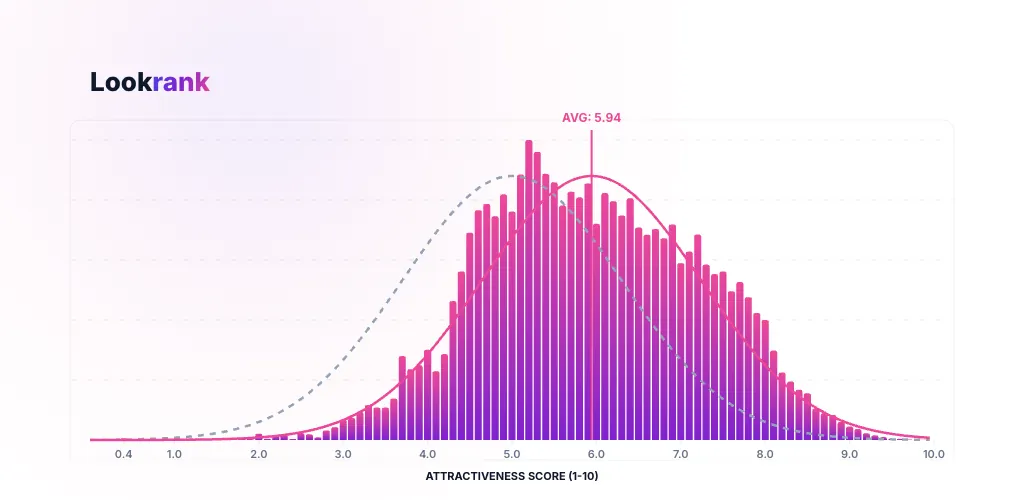
Lookrank's scores pile up around the middle of the scale. The faces at the top, the ones these headlines make you picture, are a thin slice. The counts are on the statistics page. Read against that, Hamermesh and Biddle's pay gap is attractive workers against people rated below average, and the dating 9:1 is a face weighed against a biography. Both are differences between ordinary faces, which is where almost everyone in the sample lands.
Higher-scoring Lookrank users are more likely to pay. The checkouts do not say why, and two readings both fit the cards above. One is effort: people who already try harder to be attractive are the same people who pay to have it measured. The other is money: the salary, sales, and tip gaps leave more disposable income, which is the economic side of the higher life satisfaction in Datta Gupta, Etcoff, and Jaeger. The same user can be both. A payment only shows that they paid.
References & Academic Sources
This page summarizes published research for education, and one pattern from Lookrank checkouts. It is not medical, legal, or financial advice. See the references for the primary sources.
If this stuff is messing with your head, talk to someone. A score is not help.
Edited by Alex Alstrom · [email protected]